
How to play Gerrymandle
You are in charge of drawing the district lines for the elections. Click adjacent tiles on the map to group them into a district. Each district must be one connected shape, no islands allowed.

Coloured houses show where voters live. Not every tile on the board has one, some are just empty land.

A party wins a district by having more houses in it than any other party. If two parties tie in a district, nobody wins it. It is your job to draw regions so that your party wins more regions than anyone else and wins the election.

Every house must be assigned to a district. The districts are all the same size.
Submit your answer when you think you have found the best distribution for your party. There is also a hint button available if you get stuck. Good luck gerrymandering!
What is gerrymandering?
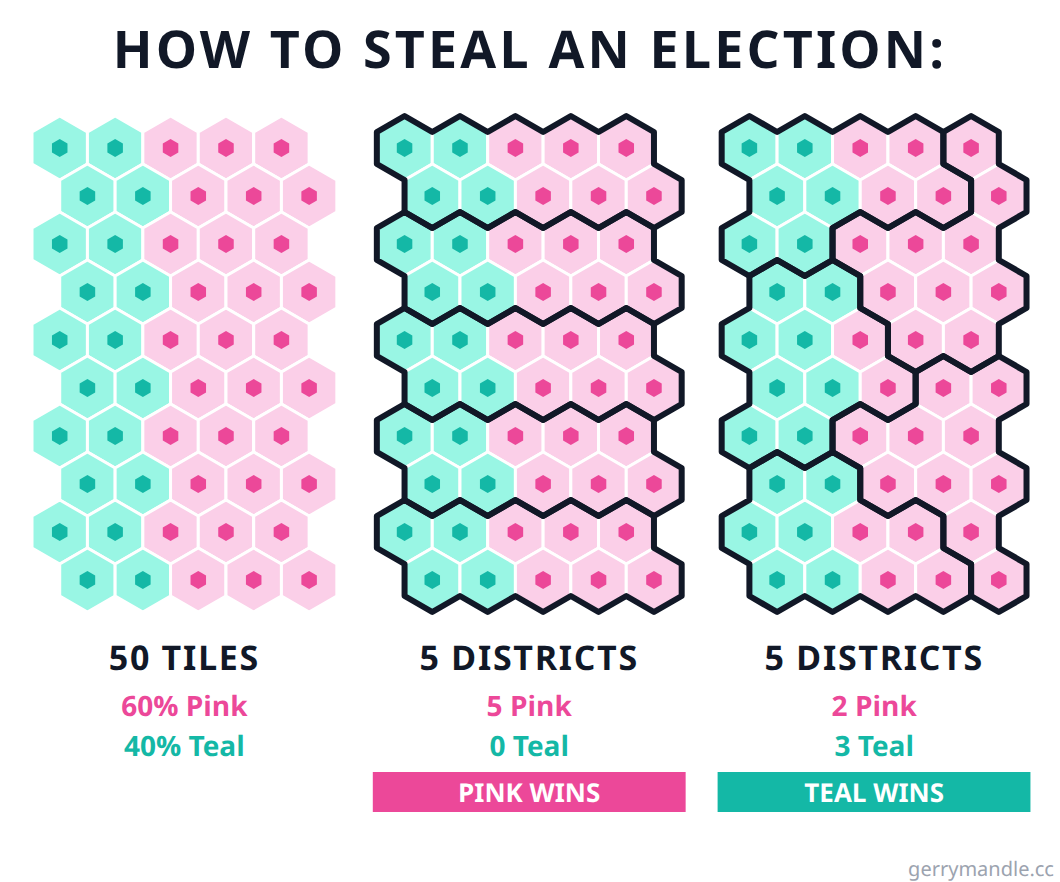
Gerrymandering is drawing electoral district lines to favour one party over another. Two techniques do most of the work. Packing concentrates opponents into a few districts they win by a landslide, burning their surplus votes on margins they didn't need. Cracking splits their remaining voters across other districts so they fall just short everywhere. Together, a party can win a majority of seats with a minority of the overall vote.
The name comes from Massachusetts governor Elbridge Gerry, who in 1812 approved a district so oddly shaped that a Boston newspaper compared it to a salamander and coined "Gerry-mander". The practice is older: Patrick Henry tried to draw Virginia's first congressional map to keep James Madison out of Congress. Today the mechanics are unchanged, but algorithms model thousands of map variants and tune each district with surgical precision.
Why is gerrymandering bad?
When a map guarantees an outcome, general elections stop mattering. The primary winner takes the seat, so incumbents only need to keep their party's base happy. The centre gets ignored; the extremes perform better.
The effects are measurable. When courts struck down North Carolina's partisan map in 2022, the state elected equal numbers of Republicans and Democrats. Republicans redrew it, and in 2024 won 10 of 14 seats in a state that is closely divided. The vote totals barely shifted. The lines did.
It also concentrates harm on minority communities. Residential patterns make packing or cracking a minority neighbourhood one of the most efficient ways to tip a district. In 2019, the Supreme Court ruled it could not police partisan maps, even while calling gerrymandering "inconsistent with democratic principles". A 2026 ruling went further, requiring proof of discriminatory intent rather than discriminatory effect alone, making maps far harder to challenge.
That ruling has accelerated an already aggressive cycle. More than 25% of all congressional seats have been redrawn mid-decade since 2020, something that used to happen only after a census, once per decade. Texas redrew its maps in 2025 to add five Republican seats. California suspended its independent redistricting commission and redrew in response. Virginia and Florida followed. Redistricting has become an ongoing political instrument.